It is a question that rarely has simple answers. In the middle of acute loss, small and almost wordless actions often become crucial to how people remember a farewell. Holding your child. Tucking them in. Wrapping the baby in something soft and dignified.
In the artistic research dissertation Hålla, famna, svepa – textil omsorg vid förlorad graviditet at University of Gothenburg, textile artist and researcher Birgitta Nordström explores the significance of specially designed wrapping blankets when a child dies. The research is based on several years of work and conversations with midwives, nursing assistants and parents within Swedish maternity and gynaecological care.
A silent language in grief
In the research, textiles are described not merely as practical materials, but as part of the human way of approaching death. Birgitta Nordström refers to the textiles as a “silent, tactile language for grief”. It concerns how fabric, weight and touch can carry and express what is difficult to put into words.
The wrapping blankets developed within the project are not ordinary hospital sheets that are washed and reused. They are carefully created for the unique encounter between the child, the parents and the healthcare staff.
The act of wrapping the child creates a protective and separate space around the body in the middle of an otherwise clinical hospital environment. The researcher’s perspective is that wrapping is not about hiding the child or creating distance, but about making closeness possible. Folding the fabric around the child contains a deep tenderness and a wish to make everything as beautiful as possible.
Structure and softness: The blanket as practical support
When the work with the blankets first began, the focus was on creating the softest possible textiles using materials such as silk and thin merino wool. But through dialogue with experienced midwives, other and more physical needs quickly emerged.
When a child dies, the body loses its natural tension. Healthcare staff described how the blanket needed not only softness, but also built-in structure and firmness. It needed to support, frame and physically stabilise the child so that parents could more easily receive and hold the baby in their arms.
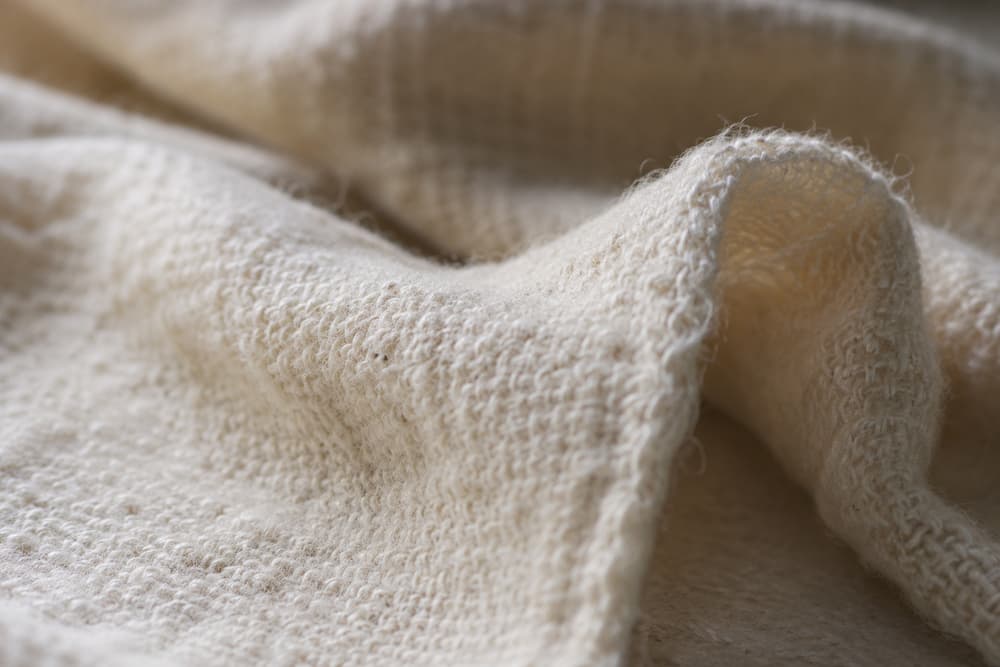
The result became a blanket woven mainly from wool, with muted colours and a restrained design. The aesthetic is intentionally minimalist. The blanket should not take over or replace the memory of the child, but simply exist as a quiet background and gentle support.
Doing something together when nothing can be done
The research also shows that the wrapping blankets serve an important purpose for healthcare staff. In meetings with parents experiencing the acute grief of loss, words are often not enough for the staff either. In that silence, practical actions can become a way of carrying the situation forward.
The dissertation describes how simple and practical questions from a midwife can open up a difficult moment:
“Would you like to hold the baby?”
“Shall we bathe the baby together?”
“May I show you how we can wrap the blanket around the baby?”
Washing, dressing or wrapping the child together creates a moment of shared care. It can help ease the feelings of loneliness and unreality that often arise in the delivery room.
Creating memories through touch
When a child dies early in pregnancy, there are often very few concrete memories for parents to carry with them into the future. In those moments, the tactile and sensory experiences during the short hours at the hospital become deeply important for the grieving process: the feeling of touch, the weight in the arms and the textile around the child’s body.
The wrapping blankets become a tool that helps parents dare to meet and create physical memories of their child. The study highlights the significant difference between encountering a dead child in a medical environment and receiving a gently cared-for child wrapped in their own blanket. The word repeatedly used by healthcare staff throughout the study is dignity.
A reminder of human care
Ultimately, Birgitta Nordström’s research is about something far greater than textiles and wool fibres. It is about the human need for care, even after life has ended.
In a modern healthcare system often marked by time pressure and medical routines, the wrapping blanket becomes a quiet reminder of something deeply human. The possibility to pause, tuck in the child and create a dignified and protected space around the person who has died through gentle acts of care. Perhaps it is precisely in these quiet and practical gestures that care becomes most visible.