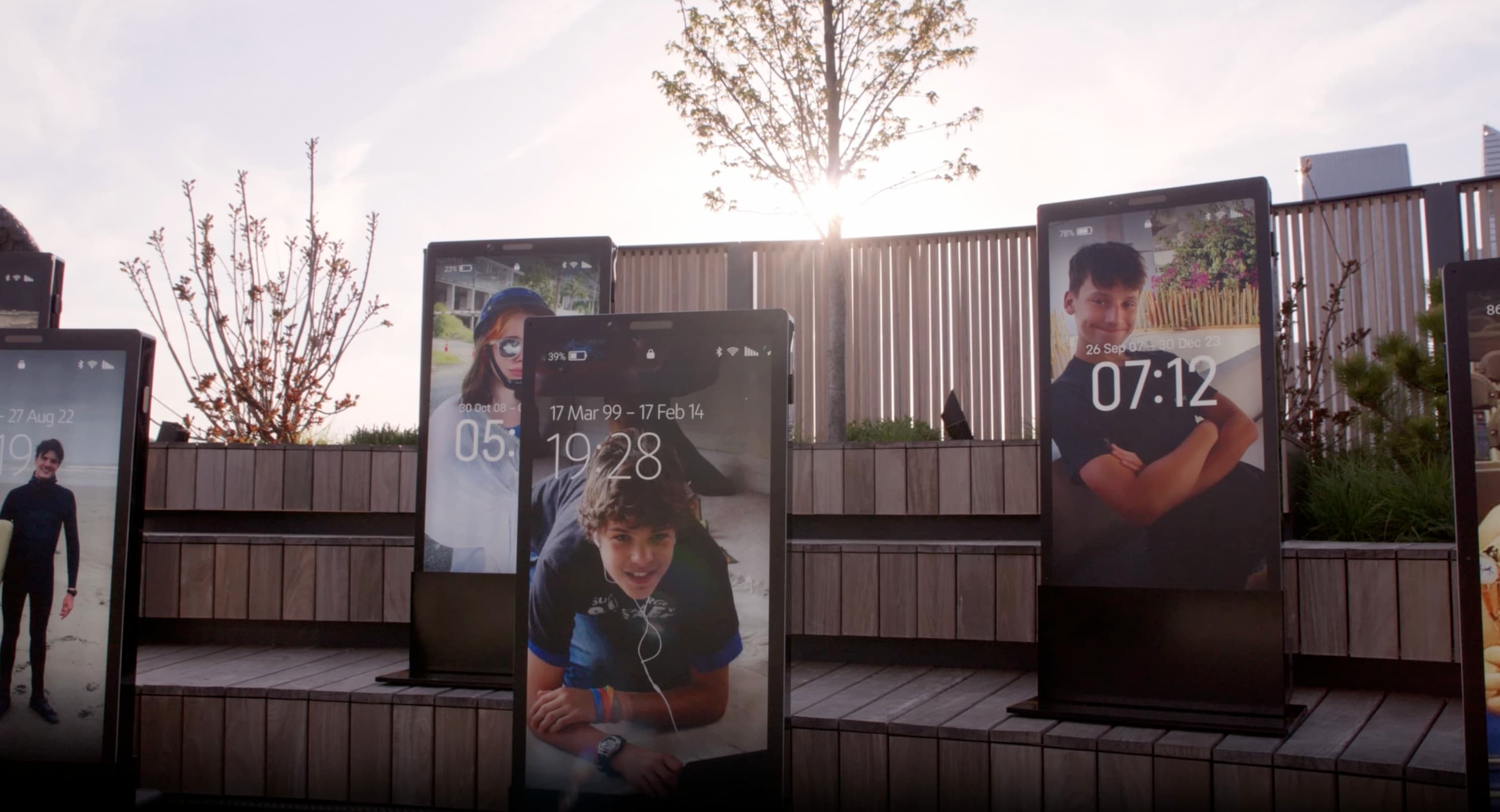
The installation The Lost Screen Memorial, recently unveiled in Geneva in connection with the World Health Assembly, represents an entirely new kind of public memorial. The monument consists of 50 illuminated large-scale mobile screens. But instead of feeds, notifications and algorithms, they display the children’s own lock screen images — the very pictures their parents used to see every time they picked up their phones.
Behind every screen is a tragedy. The memorial was created in honour of children who died as a result of cyberbullying, harmful online content, exploitation or other forms of digital harm. Yet while media coverage often focuses on technology policy and regulation, the installation also raises a deeper question: how are grief and memorial culture changing in the digital age?
The place where memories continue to live
What makes The Lost Screen Memorial so powerful is the way it transforms something ordinary into a ritual space of remembrance. For many bereaved families, the phone has become the place where the most important traces of a person remain.
Voice messages are saved just to hear a loved one’s voice again. Old text conversations, photographs and fragments of everyday life remain stored inside the device, still feeling painfully close.
The mobile phone has evolved from a communication tool into a place where lives and memories continue to exist.
The lock screen is also the first thing we see when we lift our phones. A digital threshold between the present and memory. By moving these deeply private images into public space, the memorial demonstrates that a pixel-based image can carry as much presence and grief as a photograph in an album or a name engraved in stone.
From gravestones to digital traces
The memorial also reflects a broader shift in how society approaches remembrance and farewell. Traditionally, memorial spaces have been physical and geographically tied to specific places. People visited cemeteries, gravesites or memorial locations.
Today, grief often unfolds simultaneously in digital spaces.
When the families behind The Lost Screen Memorial share their children’s lock screens, they make grief visible inside an environment otherwise dominated by speed, distraction and endless consumption. But the project does not end with the physical screens displayed in Geneva’s public square.
Through the memorial’s accompanying website, the installation expands into a digital testimony archive. Visitors can view each child’s lock screen and read or listen to the story behind the image — who the child was, what happened and the loss their family continues to carry.
This transforms the installation into a hybrid memorial: a physical monument in public space that leads into a documentary archive where the victims regain their voice, personality and story.
A new memorial culture is emerging
In recent years, digital memorial pages, virtual remembrance spaces and social media profiles that evolve into condolence pages have become an increasingly natural part of the grieving process. Our digital traces continue to exist long after life itself has ended.
This reminds us that the digital world is not only a place where harm and vulnerability emerge, but also a place where people try to remember, grieve and heal.
It also raises new questions for the bereaved. What happens to our digital lives when we die? Who gains access to the photos, messages and accounts we leave behind? And who truly owns the memory of a person when so much is stored behind passwords and cloud services?
By shifting the focus from politics to the human experience, the memorial in Geneva becomes a reminder that memorial culture is never static. It changes alongside humanity and the technologies surrounding us.
The Lost Screen Memorial is therefore not only an activist installation or a warning about social media. It is also a sign that grief itself is changing.
In a world where our lives become increasingly digital, our memories inevitably do as well. And in that transition, an illuminated mobile screen in the dark — or a preserved story inside a digital archive — can sometimes express loss more powerfully than any traditional symbol.