Sustainable coffins and urns are often presented in the media as something entirely new. For those who have worked within the funeral industry, the opposite is closer to the truth; biodegradable materials have existed for well over a decade. What is happening now is something different: the technology has finally caught up with the vision, and the design has become bold enough to genuinely become a choice.
In a time when sustainability shapes everything from energy production to food consumption, the funeral industry has also been forced to evolve. But anyone who believes environmentally friendly funeral products are purely a phenomenon of the 2020s is only partly correct. As early as ten years ago, sand urns and specialised water burial urns were already in active use. The challenge was rarely the idea itself, but rather that these alternatives existed quietly in the background – both in terms of availability and visual identity.
When the material becomes part of the story
Today, we are seeing a shift where the material is not only expected to disappear naturally, but also to contribute to a meaningful story. One of the most widely discussed examples is “Living Cocoon”, a coffin grown from mushroom mycelium and hemp. Unlike traditional wood, which in certain soil conditions can take decades to decompose, the mushroom coffin integrates into the earth in as little as 45 days. In Sweden, Fredahl Rydéns acts as a retailer, although the product has not yet become a standard feature in digital catalogues.
We have previously explored in greater detail how the technology behind mushroom coffins works.
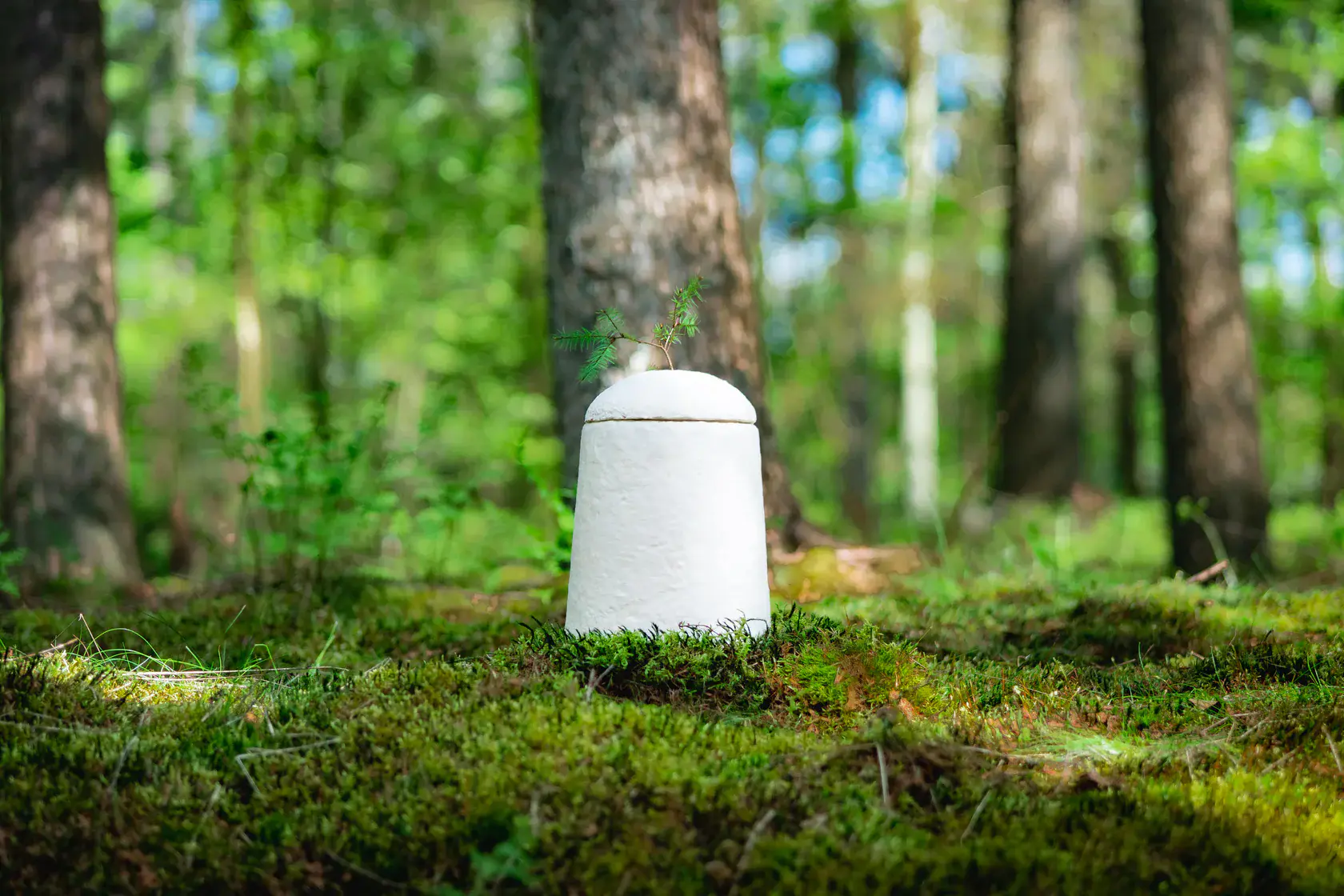
However, this movement is not only about mushrooms. New alternatives are emerging that challenge the traditional image of what a final resting place should look like. WURN works with naturally felted sheep’s wool, where the tactile and soft form creates an organic expression far removed from the hard ceramic or metal urns many people are accustomed to. At the same time, products such as Beyond Life are introducing urns made from potato starch and wood fibre pulp, delivered together with seeds. In these concepts, the ashes are planted alongside the seeds, transforming the memorial site into a birch tree or a field of blue-violet wildflowers.
Aesthetics as a driving force
Why are cardboard coffins not sold everywhere, despite projects such as Europakistan having existed for years? The answer likely lies in a combination of maturity and aesthetics. Earlier environmentally friendly alternatives were often perceived as sparse or overly simplistic.
The new solutions emerging today possess an entirely different visual strength. They are connected to ideas of natural cycles and a clear relationship with nature that resonates with modern families. These products are no longer viewed simply as an “eco-friendly alternative”, but as conscious choices shaped by how the object actually looks and feels.
An industry in motion
Despite the growing interest, the market remains uneven. A family visiting a funeral home is often guided by what is physically displayed in the showroom. If sustainable alternatives are not presented as a natural option, they remain a niche reserved for the most informed customers.
The difference today is that demand is increasingly coming from the public itself. As the media highlights coffins that rapidly reintegrate into the soil or urns that grow into trees, the industry is being forced to reposition itself.
Sustainable alternatives have existed for a long time. But only now are they beginning to look like something people genuinely want to choose.
Photo:Loop Biotech