Burial and cremation have long been the two principal choices for what happens to the body after death. But in several parts of the world, a third method is already being used: alkaline hydrolysis.
The process is often called water cremation, resomation or aquamation. Its technical name is alkaline hydrolysis. The Health Council of the Netherlands, Gezondheidsraad, uses this term because it describes the chemical process that actually takes place.
The method is already used for human remains in parts of the United States, Canada, Australia, Mexico and South Africa. Discussion about its wider introduction concerns both its environmental impact and the possibility of offering alternatives to conventional burial and cremation.
How does alkaline hydrolysis work?
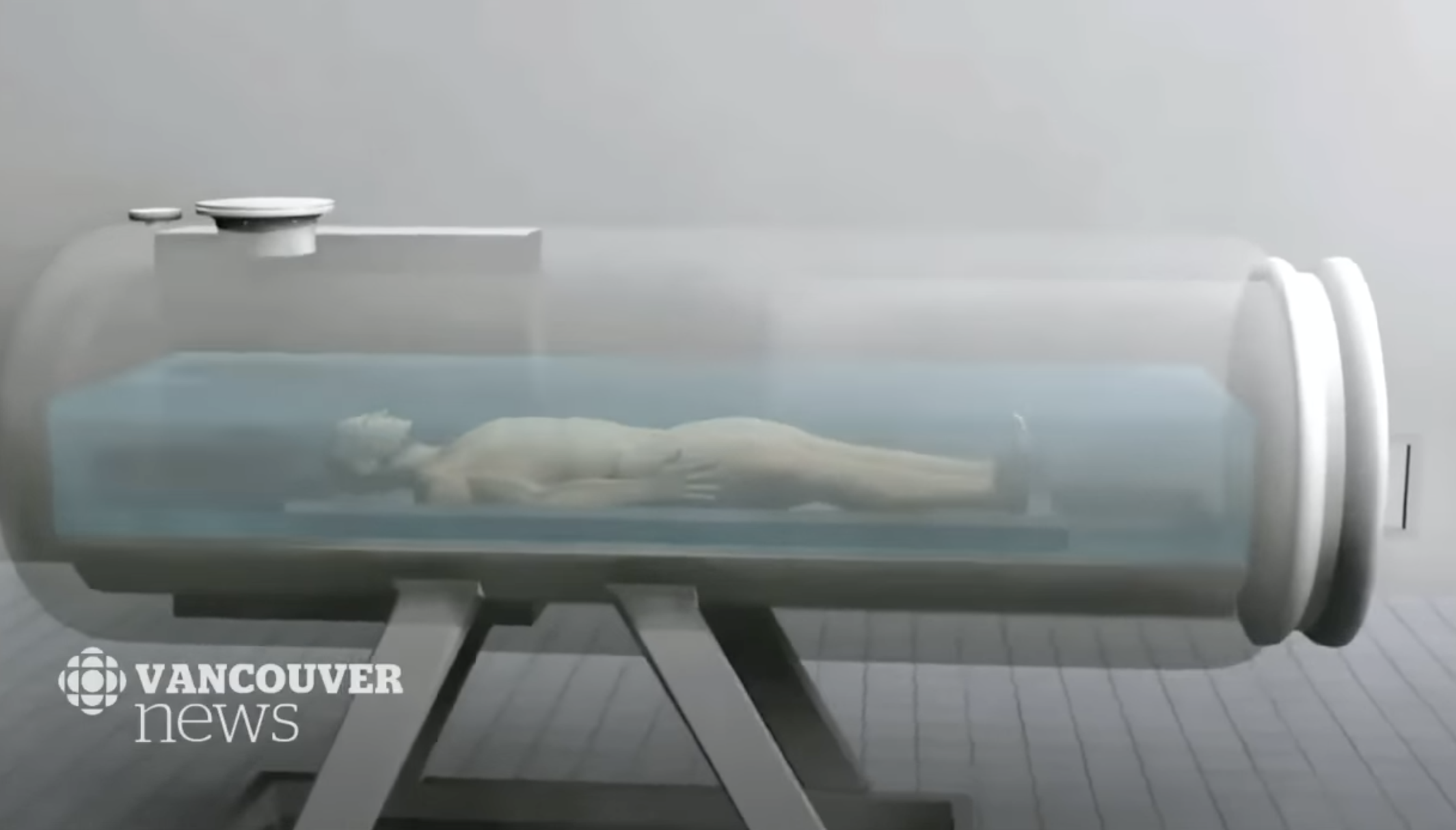
During alkaline hydrolysis, the body is placed inside a sealed steel vessel. Water and potassium hydroxide are added, and the liquid is heated under pressure.
According to Gezondheidsraad, temperatures vary depending on the type of system, typically ranging from around 100 to 150°C. The entire process takes approximately two to ten hours depending on factors including the system, temperature and body weight, and also includes cooling and rinsing.
What remains afterwards is primarily the mineral component of the bones. These remains are dried and processed into a light-coloured powder that can be returned to the family in much the same way as ashes following cremation. Implants, prostheses and other medical materials can be collected separately.
The process also produces a liquid known as effluent. Gezondheidsraad's report describes approximately 1,500 litres of effluent from the process, including water used during stages such as rinsing. The liquid contains water, potassium hydroxide and broken-down organic substances including amino acids, salts, sugars and fatty acids.
According to Gezondheidsraad's report, the effluent does not contain DNA or RNA after the process. Its high pH must, however, be reduced before the liquid can be handled further.
Despite the commonly used term “water cremation”, no combustion takes place.
What happens to the liquid?
When Gezondheidsraad revisited alkaline hydrolysis in 2025, it specifically considered concerns about the potential environmental impact of the effluent.
The council concluded that there are several possible ways of handling the liquid after the process. Which solution is appropriate depends partly on how the process is designed and on the requirements governing discharge and wastewater treatment. Gezondheidsraad concluded that methods of handling the effluent are available that could satisfy the criteria used in its assessment framework.
How the liquid may ultimately be handled therefore depends on both technical conditions and national or local regulations. Alkaline hydrolysis is consequently not simply a question of installing a machine. Introducing the method also requires rules governing the process as a whole and its resulting materials.
Is water cremation better for the environment?
One of the most common arguments for alkaline hydrolysis is that it could reduce environmental impacts compared with conventional cremation and burial.
Because the body is not burned in a cremator, there is no equivalent combustion process and no flue gases are produced by burning the body itself.
In its 2020 assessment, Gezondheidsraad concluded that alkaline hydrolysis performed better than burial and cremation from a sustainability perspective. That assessment was based on certain assumptions about how the process and its resulting materials would be managed and does not mean that alkaline hydrolysis has no environmental impact.
The process requires water, energy and chemicals, and the effluent must be dealt with afterwards. The overall environmental benefit in practice therefore depends on factors including the design of the facility, its energy use and how the resulting materials are handled.
Safety, dignity and sustainability
When Gezondheidsraad evaluated new methods for handling human remains in 2020, its assessment was based on three core values: safety, dignity and sustainability.
Its overall conclusion was that alkaline hydrolysis could meet the criteria required for it to be permitted.
The issue was assessed again in 2025, including new information about the process and the handling of its effluent. Gezondheidsraad found no reason to change its previous positive assessment of alkaline hydrolysis.
The Netherlands has already built two facilities
The Netherlands provides an unusually concrete example of technology moving ahead of legislation.
In January 2022, the country's first resomation machine was installed at Nieuw Eykenduynen in The Hague. In September 2023, another facility opened at the 't Vijfde Seizoen funeral centre in Ommeren, where a fully functioning alkaline hydrolysis system has been installed.
Neither facility has been able to begin carrying out resomations because current Dutch law does not yet permit the method.
On 25 September 2026, however, the process took a significant step forward. The Dutch government submitted its proposed new Wet bestemming lichamen overledenen to the Council of State, Raad van State, for review. The bill explicitly proposes allowing resomation as a new method for handling the body after death.
The proposal has not yet been adopted, and there is consequently no date for when the first legal resomations could take place in the Netherlands.
Read more in Eftertid's article about the new Dutch funeral law proposal. [internal link]
History offers a remarkable parallel
This is not the first time funeral technology in the Netherlands has moved ahead of legislation.
The country's first crematorium, Westerveld, was built in 1913, and its first cremation took place in 1914. It was not until several decades later, in 1955, that cremation gained an explicit legal basis in Dutch legislation.
More than a century later, the Netherlands once again has completed funeral infrastructure waiting for the law to catch up.
A changing legal landscape in Europe
The question facing the Netherlands is increasingly relevant elsewhere in Europe as well.
In Scotland, a specific regulatory framework for alkaline hydrolysis came into force on 2 March 2026. The Scottish Government states that there are currently no providers offering alkaline hydrolysis in Scotland, but the legislation now provides a framework under which the method can operate.
England and Wales are considering a different regulatory approach. In June 2026, the Law Commission published its final report on new funerary methods together with draft legislation. Rather than approving alkaline hydrolysis directly, it recommends creating a regulatory framework through which new methods could be assessed and approved.
The developments illustrate a broader challenge for funeral legislation. Many existing legal systems were designed around a fundamental choice between burial and cremation. Alkaline hydrolysis does not fit neatly into either category.
A third option?
Alkaline hydrolysis is already used in several parts of the world. If it becomes established in more countries, the longstanding choice between burial and cremation will increasingly be joined by a third option.
But the question involves more than the technology used to break down the body. Alkaline hydrolysis requires decisions about how the process should be regulated, what should happen to its resulting materials and how the mineral remains should be handled.
The Netherlands demonstrates one way such a transition can unfold. Scientific assessment came first, followed by the construction of the first facilities. Now there is a concrete legislative proposal on the table.
The next formal step is the Council of State's review of the bill. The government can then proceed with the legislation to parliament.
If the law is ultimately adopted, the Dutch facilities that have so far stood ready but unused may finally be able to serve the purpose for which they were built.