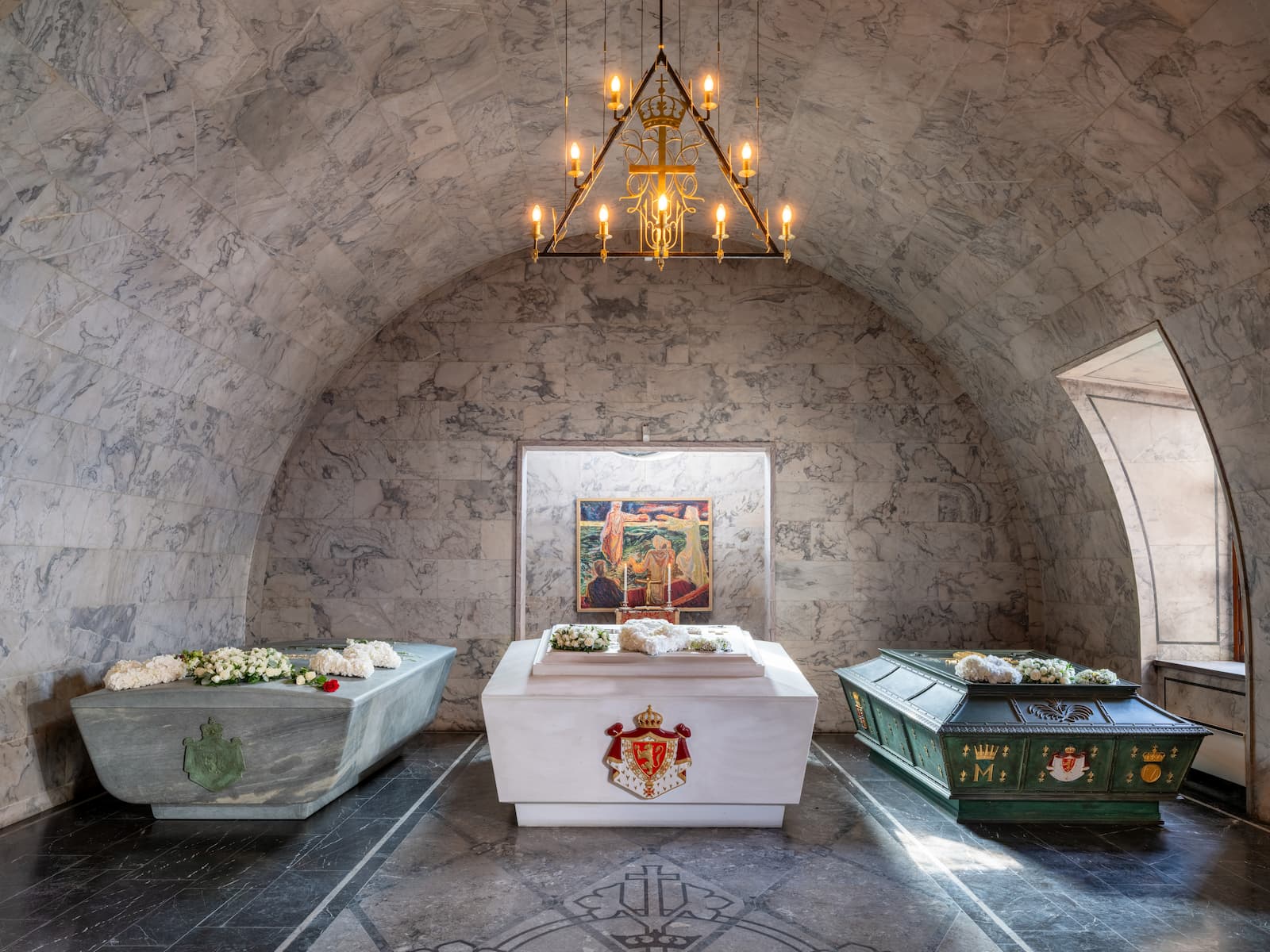
King Harald died peacefully at Rikshospitalet at 6:35 a.m. on Friday, 28 August. Following the funeral at Oslo Cathedral, his coffin was carried in procession to Akershus Castle Church, where a private memorial service was held before the coffin was lowered into the crypt. According to the Royal Court, it was later placed in the sarcophagus.
A decision made in advance
The story began two years earlier. In 2024, the decision was made to create a new sarcophagus as the final resting place of both King Harald and Queen Sonja. The commission was awarded to architecture firm Snøhetta, with Kjetil Trædal Thorsen in charge, in accordance with the couple’s own wishes. The media were not permitted to photograph the work.
The King himself addressed the project. When the cost of NOK 20 million in the state budget was debated, he joked at the annual parliamentary dinner that the figure might bring the Egyptian pyramids to mind. According to Dagbladet, he thanked the authorities for their consideration “in the hereafter”, said he hoped the sarcophagus would be well padded and pointed out that they would, after all, be there for some time.
The existence of the planned sarcophagus had therefore been known for some time, but its appearance had not. According to Dagbladet, it was completed earlier in September, after the King’s death but before the funeral. The Palace confirmed that it was finished but said the public would not see it until the King had been laid to rest inside it. It was unveiled on 18 September.
A ship for two
The sarcophagus is shaped like a vessel with a rounded hull. The Royal Court says the design was inspired by Harald’s close relationship with the sea: a hull protects those aboard and carries them safely onwards. According to the Court, the motif also draws on the older Nordic tradition of ship burials. The material, olivine stone from Sunnmøre, is explained by the Court through Queen Sonja’s connection with the region: she has spent considerable time hiking in the Norwegian landscape and knows Sunnmøre well. This is the Royal Court’s interpretation of the design, rather than something independently established elsewhere.
But the form and material tell only part of the story. The sarcophagus was also built for two. The Royal Court says Queen Sonja will one day be laid to rest there alongside Harald.
The people behind it
The sarcophagus consists of ten large sections of stone from Vassbakkedalen in Volda. The pieces were worked and finished by Johansen Monumenthuggeri in Skjeberg, Østfold, which also installed the sarcophagus. Askim Mekaniske Verksted reinforced the stone with steel, while the green peridot stones in the crowns were cut and polished by Harald Kvarsvik and Berit Marie Engvik on Averøy. The royal regalia symbols were cast in bronze at Kristiania Kunst- & Metalstøberi, while the lettering was waterjet-cut in Sande, Vestfold.
Behind the royal commission, then, are trades also familiar from far more ordinary memorials: stonemasons, metalworkers and installers.
A room that waits
The mausoleum at Akershus now contains three double sarcophagi. King Haakon VII and Queen Maud rest in the white one; King Olav V and Crown Princess Märtha in the dark green one. The new sarcophagus stands to their left.
The sarcophagus was created from the beginning for two people. It now has its first occupant. Beside King Harald is the place that has always been intended for Queen Sonja, making it both a completed grave and a place that is still waiting.