The first months of operation indicate that energy consumption has been lower than expected, while staff describe the working environment as significantly quieter and cleaner than before.
Better than expected
After the first approximately 60 cremations carried out in the new furnace, energy performance proved to be better than anticipated, according to Thomas Nilsson, the landscape architect and project manager who has overseen the development since its inception. Asbjörn Karlsson, Head of Property and Grounds Maintenance at the cemetery administration, confirms the same experience: the facility is both quieter and cleaner than a conventional oil-fired cremation furnace – a difference noticed by both staff and the bereaved families who visit the building.
Skogsäng also serves as a backup crematorium for the island of Gotland. According to the project team, the facility has attracted visitors from across Sweden – from Kiruna in the far north to Skåne in the south – who have come to study the technology firsthand.
Replacing a 60-year-old crematorium
Oskarshamn’s previous crematorium had been in operation since 1963 and was in urgent need of modernization. Among other shortcomings, it lacked a dedicated room for bereaved families. Following a planning process that began with feasibility studies in 2020 and parallel architectural commissions in 2023, the new Skogsäng facility was completed adjacent to Västra Cemetery and the Forest Chapel. The project cost SEK 117 million and was financed through loans secured against future burial service fees.
What makes an electric cremation furnace different?
Most of Sweden’s 58 crematoria currently operate using RME or HVO – renewable alternatives to fossil fuel oil. However, these are still combustion-based systems in which a burner maintains an open flame. An electric cremation furnace works on an entirely different principle: instead of a flame, the cremation chamber is heated by electric heating elements.
Following a study visit to the Netherlands and procurement processes that also included oil- and biogas-fired alternatives, Oskarshamn selected a Swedish-built hybrid furnace manufactured by MITAB in Forsbacka (model MKR24EH). The furnace is heated by seven electric heating elements supplied by Kanthal and can reach temperatures of up to 1,200°C (2,190°F). A cremation takes approximately 78 minutes and consumes around 200 kilowatt-hours of electricity. Although classified as a hybrid system and still equipped with a conventional burner as a backup component, normal operation relies entirely on electric heating.
Major emission reductions – and the energy is reused
According to calculations by the Church of Sweden, switching to electric operation reduces carbon dioxide emissions by approximately 97 percent, compared with around 70 percent for RME and 85 percent for HVO. The heat generated during the cremation process is also put to use. Around 70 percent of the supplied energy is recovered and fed into Oskarshamn’s district heating network.
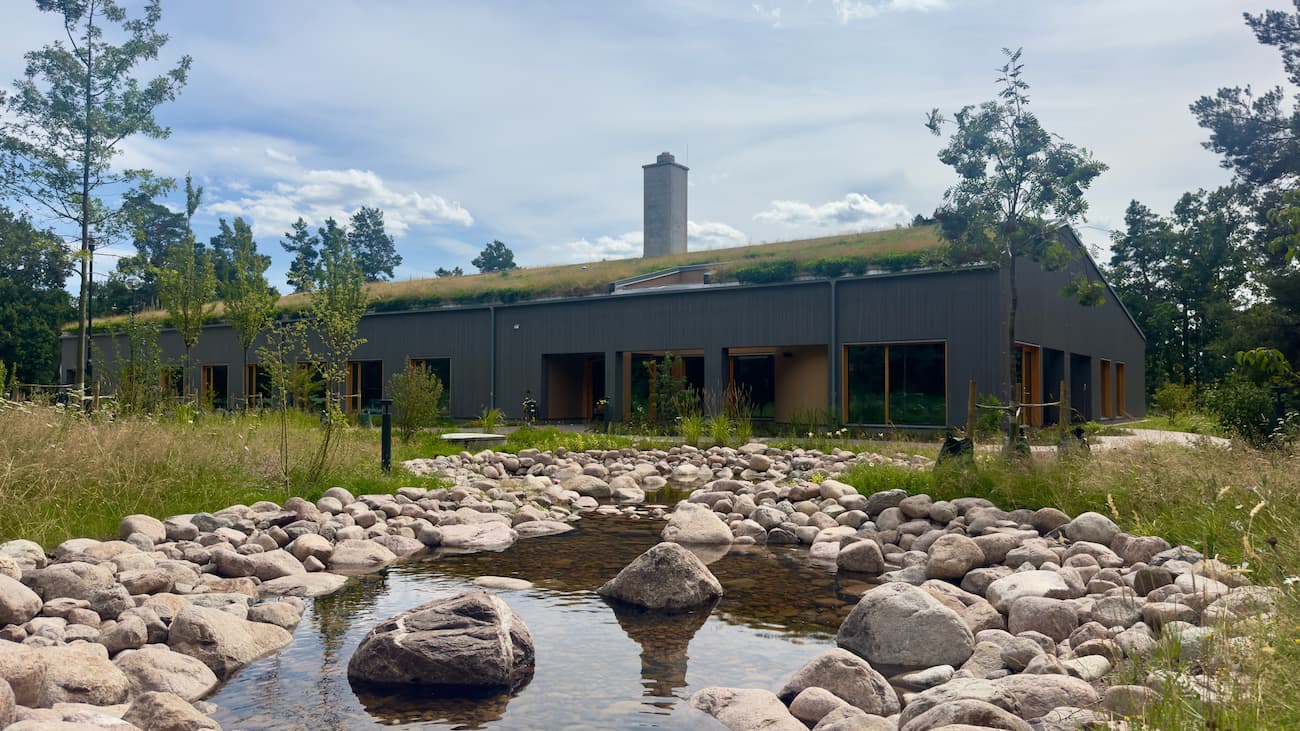
The building itself has been constructed as a low-energy timber building featuring green roofs and approximately 450 square metres of solar panels. Rainwater from the roof is collected and used for irrigation and to supply a pond within the cemetery grounds. According to those involved in the project, the building could eventually become an energy-positive facility, producing more energy over the course of a year than it consumes.
A carefully designed family room
Beyond the technology, considerable attention has been given to the human experience. The family room, named Fjärilen (“The Butterfly”), is located directly beside the cremation furnace, allowing relatives to be present when the coffin enters the furnace or to collect an urn in a calm and dignified setting. The room features a stylised glass tree created by the Målerås Glassworks.
Part of a broader transition
Oskarshamn is not the only Swedish crematorium moving away from fossil fuels. In March 2026, the Forest Crematorium in Skövde was inaugurated with electric cremation furnaces as well. Together, the two projects represent a clear direction within the Church of Sweden, which has set the goal of becoming fossil-free.
Sources: Church of Sweden / Diocese of Växjö (“A Unique and Climate-Smart Crematorium in Oskarshamn”, published 11 December 2025); Barometern (“Unique Crematorium Inaugurated – ‘A Great Day for the County’”, published 25 November 2025); Swedish Cemeteries and Crematoria Association (SKKF), presentation on Oskarshamn’s new crematorium (SKKF Visby Conference, 12 September 2024).