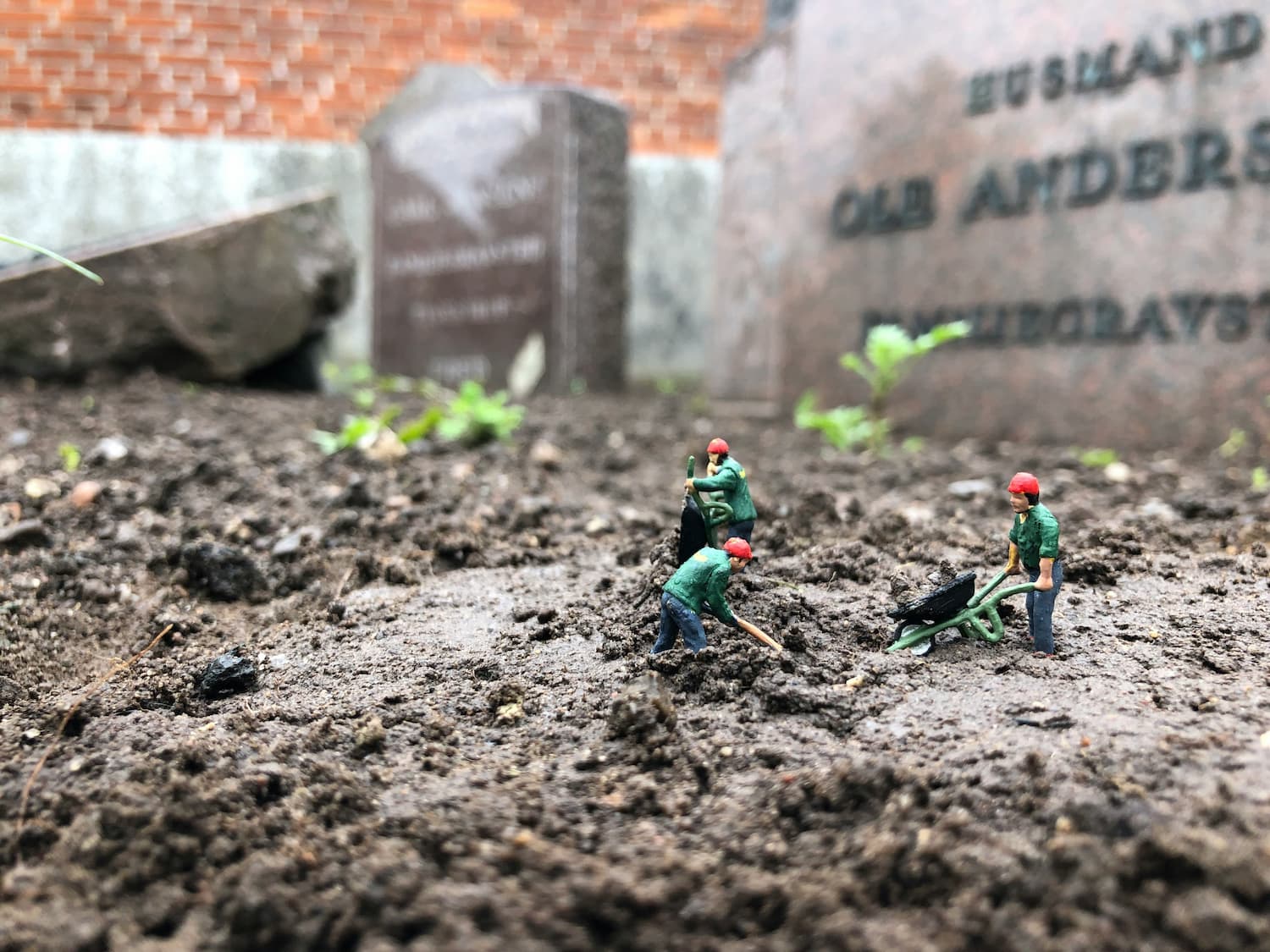
In Gothenburg, the local burial authority is planning for the possibility of burying nearly 30,000 people without cremation if a major crisis or war makes it necessary. On the island of Gotland, Church of Sweden personnel have practised digging graves by hand. And in Roslagen, north of Stockholm, the Church of Sweden, the Swedish Armed Forces and several government agencies have rehearsed identifying, transporting and burying simulated war casualties.
These are different parts of the same public responsibility: ensuring that the dead can be cared for, even when the conditions for ordinary funeral and burial operations change fundamentally.
Emergency preparedness is not only about saving lives. Society must also be able to care for those who die.
When modern infrastructure fails
Modern funeral and burial services depend on infrastructure that rarely attracts attention while it works. Graves are dug using machinery, crematoria rely on sophisticated furnace systems, and deceased people are kept in temperature-controlled facilities. Digital records document where people are buried.
During a major power outage, fuel shortage or war, several of these functions could be disrupted simultaneously.
In 2023, Gothenburg's burial authority described how it was preparing for such a situation. Its planning included hand tools, personnel and the ability to document burials on paper if digital systems became unavailable.
The Church of Sweden's national office, following consultation with the former Swedish Civil Contingencies Agency (MSB), recommended that burial authorities should maintain additional land sufficient for coffin graves equivalent to five per cent of the population. This is a recommendation, not a statutory percentage requirement.
For Gothenburg, that corresponds to nearly 30,000 people. In March 2023, the authority estimated that approximately 15 hectares of emergency burial land would be needed. Its guidelines for 2026–2029 describe the reservation of such land as ongoing work.
Can crematoria keep operating?
A central assumption in Gothenburg's planning is that burials must remain possible even without crematoria or mechanical excavators.
But is it inevitable that cremation must stop when the electricity supply is interrupted?
That question was examined in Kremation i kris och krig (Cremation in Crisis and War), a study commissioned by the Foundation for Crematorium Technology Research, administered by the Swedish Cemetery and Crematorium Federation (SKKF).
Experiments in Norrköping, with comparative tests in Karlstad, investigated how crematorium equipment and refrigerated storage facilities perform during power outages.
During a 60-hour experiment, the temperature inside a test coffin rose from 5.2°C to 7.8°C. Based on that result, the researchers assessed that the mortuary facility examined could probably withstand a complete power outage lasting up to 72 hours without additional measures. However, the assessment was based on a test involving a single coffin.
The experiments also showed that cremation furnaces could continue operating with relatively straightforward adaptations to existing emergency systems. But there were important limitations. In one test, flue gases bypassed the cleaning system, which was not permitted under the facility's environmental permit. In another, full flue-gas treatment was used, but the lack of ventilation affected working conditions.
Several supporting systems also lacked backup power, including ash-processing equipment and a coffin lift. The experiments used watermelons inside the coffins rather than human remains, and both crematoria had furnaces from the same manufacturer.
The study therefore demonstrates possibilities, but not that crematoria in general can continue operating normally during a prolonged crisis.
Nevertheless, the report's authors recommend that cremation should remain the primary option even during crises, with burial without cremation as a contingency.
Putting preparedness into practice
Alongside these technical investigations, practical exercises are taking place.
During the Swedish Armed Forces' Aurora 26 exercise, held from 27 April to 13 May, the Church of Sweden joined the Police Authority, the Swedish Tax Agency and the Swedish Defence Conscription and Assessment Agency in a war-graves exercise in Roslagen.
Participants practised handling simulated war casualties, from identification and transportation to burial. According to the Church of Sweden, it was the first time all these organisations had conducted such an exercise together.
The Church describes an ambition for every fallen person to eventually be laid to rest at a burial ground in their home community. At the same time, war-graves services follow the principle of using the nearest possible burial ground, regardless of religious or other background.
On Gotland, a different form of preparedness was practised on 8 October. Personnel from Church of Sweden parishes in the Diocese of Visby trained to dig graves by hand, a skill that could become essential when machinery or fuel is unavailable.
What is normally a routine mechanical task could once again become demanding manual labour during a crisis.
The hardest question remains unanswered
There is a fundamental difference between managing a power outage lasting a few days and caring for large numbers of deceased people during a prolonged emergency.
The crematorium study acknowledges this limitation. Continued operations depend on the number of deaths not rising dramatically. If many people need to be cared for simultaneously, storage capacity could become the limiting factor.
This is also why emergency burial land, backup power and manual working methods need to be seen as parts of the same preparedness effort rather than competing solutions.
The issue has also gained renewed political attention. In October 2026, the Swedish government proposed clarifying the Burial Act to explicitly require burial authorities to maintain a planned and staffed wartime organisation. The proposal has not yet been adopted. The government has also instructed the Swedish Agency for Public Management (Statskontoret) to review the responsibilities, governance and preparedness of funeral and burial services. The review is due by 27 May 2027.
How well these different measures would work together during a prolonged crisis involving many deaths remains an open question. Some emergency planning may also be subject to confidentiality, making it difficult to obtain a complete public picture.
Even when society faces its greatest challenges, one fundamental responsibility remains: caring for the dead with respect and dignity, however profoundly the circumstances may have changed.