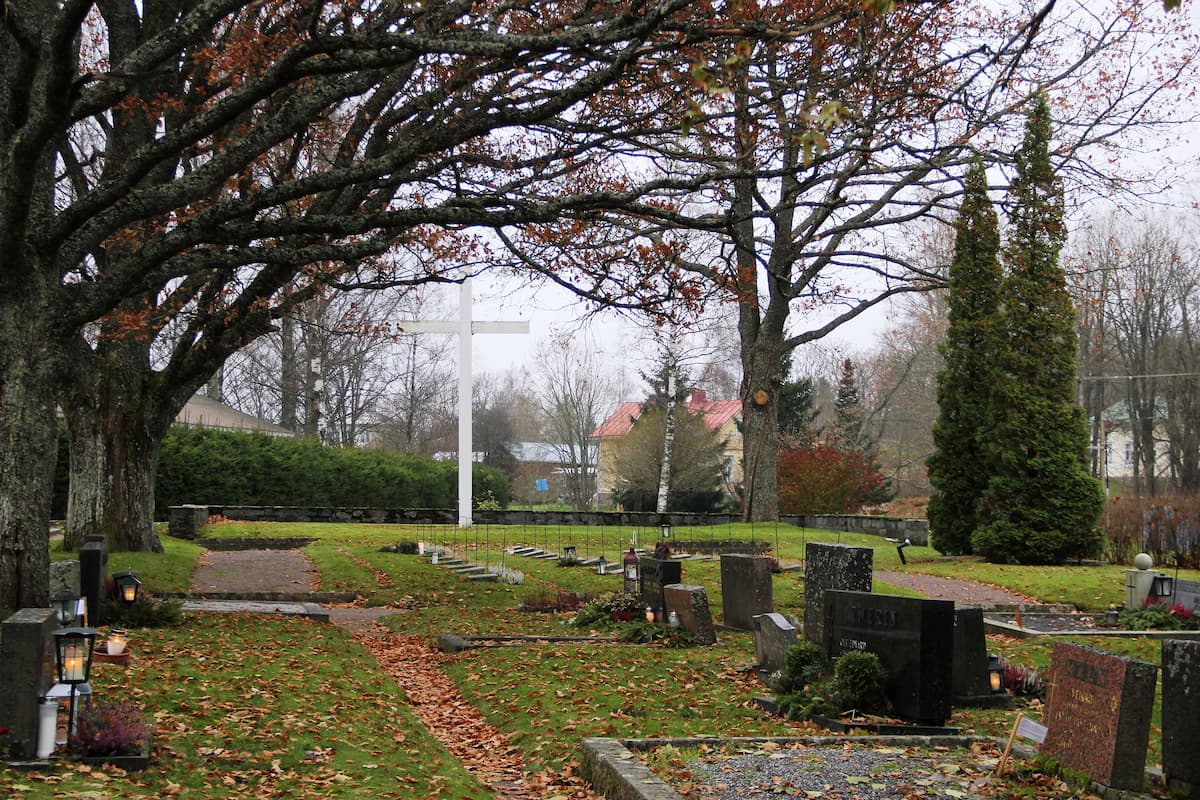
The increase is largely driven by reduced state funding for the Evangelical Lutheran Church, which is responsible for providing burial grounds for all residents, regardless of church membership.
From €68 to more than €2,200
Yle reviewed the fees charged by 165 of Finland’s 354 parishes, using data from the Church Council. The differences are substantial: the least expensive urn burial is available in Närpes, where a local resident pays from €68, while a coffin burial in Porvoo (Borgå) can cost more than €2,200 for the burial plot and mandatory cemetery services alone – the highest fee in Finland.
The comparison includes only mandatory costs: the burial plot, grave excavation and backfilling, as well as the basic preparation of the grave. The coffin, possible cremation, urn, headstone and memorial gathering are additional expenses, making the total cost considerably higher.
State funding has been cut in half
According to Yle, the rising fees are the result of government cuts to state funding for the church. Niilo Pesonen, Director General of the Church Council, says that government funding for the church’s statutory responsibilities now covers less than 50 percent of the costs. Before the current government’s reductions, the figure was around 80 percent.
The Church Council recommends that parish fees should cover half of funeral costs. In practice, however, few parishes reach that level. According to the church’s funeral services expert, Jani Kärkkäinen, the fees covered only about 26 percent of actual costs on average last year – a level considered unsustainable in the long term.
Local fee increases
In the Karelian parish of Kontiolahti, the combined fee for a coffin burial was increased from €260 to €490. The parish’s Chief Financial Officer, Soile Luukkainen, says that even the new fee is insufficient. According to her, the actual cost of a burial and preparing the grave amounts to around €1,500 per grave, excluding staff working hours and 25 years of future grave maintenance. She says she spent nearly a decade advocating for a fee increase, but political opposition delayed the decision.
In Porvoo, where Finland’s highest funeral fee is charged, cemetery manager Krista Jussila says the parish has reached its limit – even though the €2,245 fee covers only half of the actual costs. The local cemetery is one of Finland’s oldest, with demanding terrain where digging a single grave can take up to six hours. Rather than introducing further fee increases, the parish now aims to improve efficiency and reduce maintenance levels.
No legal obstacle – but a question of funding
Pauli Rautiainen, Associate Professor of Social Law at the University of Helsinki, sees no legal problem with large differences in funeral fees between municipalities. From a legal perspective, he compares the fee to an admission ticket for a public swimming pool rather than a state-regulated healthcare charge, since Finland has no legislation requiring uniform funeral prices.
However, he points to a more fundamental issue: when the state assigns parishes a statutory responsibility, it should also provide sufficient funding. According to Rautiainen, the reduction in state support affects the lower middle class particularly hard. Pesonen also warns that in some parishes, church tax revenue is effectively being used to finance everyone’s funerals, regardless of membership, raising questions about equal treatment of church members.
A different model in Sweden
The situation in Finland highlights a clear difference from the Swedish system. In Sweden, burial services are financed through the mandatory burial fee, which is paid through the tax system by everyone registered as a resident with taxable income, regardless of membership in the Church of Sweden. The Legal, Financial and Administrative Services Agency (Kammarkollegiet) sets the rate each year, and for 2026 it amounts to SEK 0.292 per SEK 100 of taxable income. The fee is uniform across virtually the entire country, with the only exceptions being the municipalities of Stockholm and Tranås, which administer their own burial services and may therefore apply different rates.
Finland’s experience illustrates how different funding models directly affect what bereaved families ultimately have to pay. While local fees in Finland largely reflect the financial situation of individual parishes, Sweden finances burial services collectively through the national burial fee. The contrast demonstrates how the same public responsibility can lead to very different financial consequences depending on how the system is designed.
Source: Yle, “Hautaamisen hinnat nousseet paikoin räjähdysmäisesti Suomessa – kirkon mukaan tämä on vasta alkua”, published 22 May 2026.