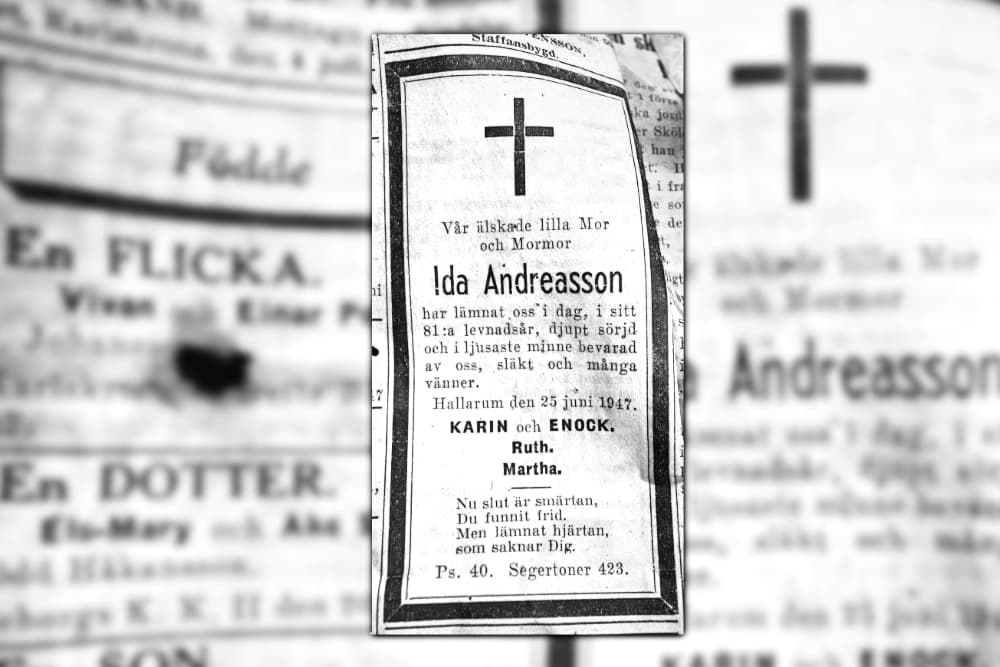
In a research article by Karin Wenzelberg, published through the University of Gothenburg, death notices are described as having become increasingly personal over recent decades. Symbols are now used more often to express the identity of the deceased rather than religious affiliation.
The research was conducted by Lena Rogström, associate professor of Swedish at the University of Gothenburg, and Catrin Norrby, professor of Scandinavian languages at Stockholm University. Together, they analysed more than 1,000 death notices published in Dagens Nyheter, Svenska Dagbladet and Hufvudstadsbladet between 2019 and 2020.
From religious symbol to personal story
When the first death notices began appearing during the nineteenth century, they were small and restrained announcements. It was not until the middle of the century that notices adopted the format still recognisable today: a framed layout containing a name, dates, a symbol and funeral information.
For a long time, the symbols were almost exclusively religious. The cross dominated completely, sometimes accompanied by a Star of David or symbols connected to different religious or fraternal orders. But according to the researchers, an important turning point came in 1976, when a death notice was published featuring a flower instead of a cross.
Since then, the development has accelerated. Today, symbols often reflect the personality, profession, interests or lifestyle of the deceased. They may include anything from sailboats and dogs to tools, wine glasses or the emblem of a favourite football club.
“It seems increasingly important to express the identity of the deceased in these public death notices,” Lena Rogström says in Karin Wenzelberg’s article.
The researchers also describe how some symbols have become so personal that only close family and friends fully understand them. One example mentioned in the study is a steaming coffee cup. To outsiders, the symbol may appear difficult to interpret, but for the family it likely carried a deeply personal meaning.
Mourning becomes more personal
At the same time, the research shows that the overall structure of death notices has changed surprisingly little during the past hundred years. The familiar composition remains: symbol, name, dates of birth and death, memorial verse and funeral information.
What has changed is the tone and content. Earlier notices often referred simply to “family and friends”. Today, relationships are specified in greater detail. Stepchildren, grandparents, in-laws and extended family members are increasingly mentioned by role and relation.
The language has also shifted slightly. Words such as “beloved” are now more common than older and more formal terms. Yet the funeral information at the bottom of the notice still often reflects traditional phrasing and ceremonial language.
According to the researchers, this development may reflect both changing family structures and a growing need to publicly express closeness, belonging and identity.
A public memory of a private life
Despite the digitalisation of much of everyday life, the death notice remains one of the few family announcements that still holds an established place in printed newspapers. At the same time, these notices are becoming increasingly personal and identity-driven.
In many Swedish notices, the cross has gradually given way to symbols that say something about who the person was in life, not merely that they have died. This transforms the death notice into something more than practical funeral information. It also becomes a final public portrait of a human being.
From newspaper notice to digital memory
The research clearly shows that the need to highlight the unique individual and the personal story is stronger than ever. At the same time, the traditional structure of the death notice has remained surprisingly stable.
Perhaps this is why more memories and personal stories are now continuing into digital spaces. There, grief is no longer limited by newspaper columns or symbol libraries, but can expand through photographs, music, texts and personal memories that continue to live on long after the notice itself has been published.
It says something important about our time. The need for rituals and public farewells remains strong, but the forms through which we express them are changing.
Source: University of Gothenburg. Research article by Karin Wenzelberg.